
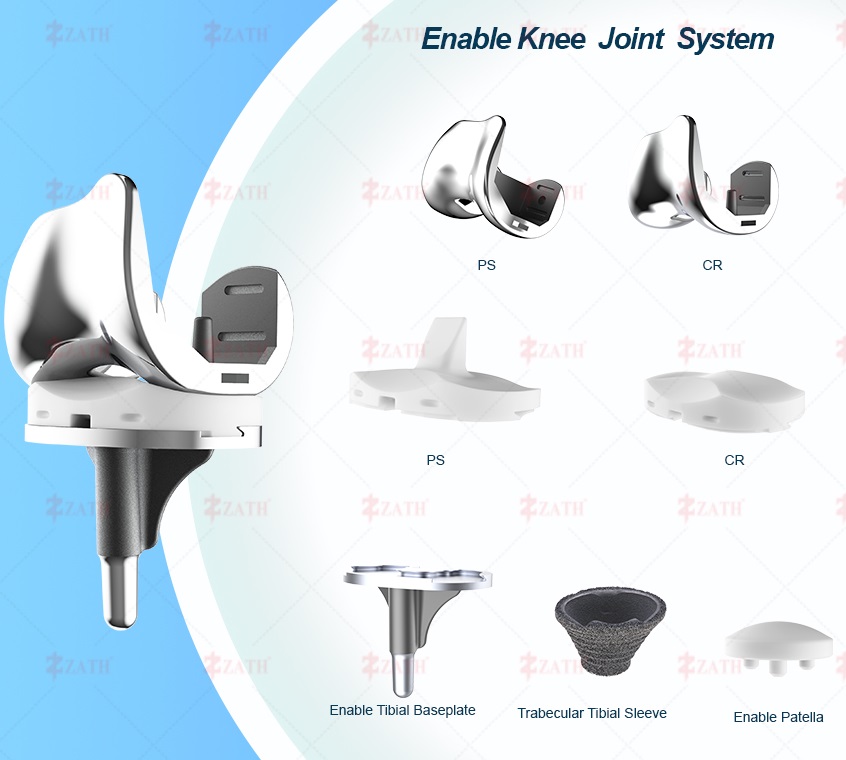
Artificial knee joint is composed of femur component, tibia component and patella, which can simulate the function of human knee joint and replace diseased or damaged joints.
How to choose a knee prosthesis?
At present, knee arthroplasty can be divided into partial knee arthroplasty (unicompartmental knee arthroplasty) and total knee arthroplasty (TKA)
Partial knee arthroplasty (unicompartmental arthroplasty)
Partial Knee Implant is a true surface replacement with minimal surgical trauma, preservation of anterior and posterior cruciate ligaments, rapid postoperative recovery of joint function, close to normal knee motion, and good joint mobility and gait can be obtained. With unique advantages and indications, it serves as one of the preferred treatments for lesions confined to a single tibiofemoral compartment of the knee. However, UKA has few indications and a high rate of postoperative partial tibial loosening, which limits the application of UKA in clinical cases.
Total Hip Replacement Implant
Total Knee Implant are widely used in knee arthroplasty. The main types used clinically are as follows:
Posterior Cruciate Lligament-preserving prosthesis: This prosthesis knee joint mainly relies on the posterior cruciate ligament of the joint, so as to ensure the posterior stability of the tibia. It has a relatively low degree of fit and a relatively small restriction. The stress generated by the human joint movement is absorbed by the ligament, and the pressure of the prosthesis is greatly reduced. In the joint surgery with preservation of the posterior ligament, the load on the posterior part of the joint is relatively large, which may increase the wear of the polyethylene insert of the prosthesis. Therefore, it still needs to be further studied and improved in clinical practice.
Posterior Cruciate Ligament-free prosthesis: The design of this knee joint prosthesis is focused on increasing the level of stability and reducing the stress in contact with the prosthesis. It has a high degree of anastomosis and usually has a CAM design. Its advantages include the removal of the posterior cruciate ligament, providing balance and stability for flexion and extension activities; Increasing the joint flexion by increasing the gap of flexion; The prosthesis has high stability and is also suitable for patients with knee valgus and flexion deformity. Its disadvantages are as follows: the high degree of gap anastomosis makes the stress concentrated through the prosthesis, increases the load of the femoral section, and has a higher rate of late loosening than the posterior cruciate ligament-preserving prosthesis. The amount of bone removed by prosthesis installation is relatively large, which makes the revision surgery more difficult. The posterior cruciate ligament-free prosthesis has a wide range of indications, and the specific surgical procedure is relatively easy. It is a widely used type of prosthesis in medical treatment at present.
If you want to learn more about the knee arthroplasty implant knowledge, please feel free to contact us; our team will provide you with the professional support and answers.
Post time: Sep-23-2026