
How to Choose an Appropriate Femoral Intramedullary Nail?
Selecting an appropriate femoral nail requires a comprehensive evaluation of the patient’s fracture type, anatomy, bone quality, surgical approach, and the surgeon’s technical preferences, leading to individualized decision-making. The main assessment criteria are as follows:
I. Selection based on fracture location and type (Indications)
Proximal femoral fractures (intertrochanteric and transcervical):
Standard intramedullary nail (such as standard PFNA): Indicated for intertrochanteric fractures (such as type 31-A1, 31-A2), reverse intertrochanteric fractures (type 31-A3), and high-level fractures (32-A1). The standard model is non-reamed and suitable for patients with good bone quality and relatively stable fractures.
Extended intramedullary nail (such as extended PFNA): Indicated for low subtrochanteric fractures, fractures with the fracture line extending beyond the distal end of the lesser acetabulum by more than 3 cm, ipsilateral acetabular fractures, multiple fractures, pathological fractures, or osteoporotic patients. Extended types require cannulation and can provide better full-length fixation and anti-rotation stability.
Other types (such as InterTan, Gamma nail): The InterTan (double nail combined with cable) is suitable for severely comminuted fractures requiring compression; the Gamma nail is indicated for relatively simple, stable fractures or subtrochanteric fractures.
Femoral shaft (midsection) fractures: The preferred choice is the anterograde locking intramedullary nail. The appropriate diameter and length of the intramedullary nail should be selected based on the width of the medullary cavity and the degree of comminution of the fracture.
Distal femoral (condylar upper/intercondylar) fractures: The preferred treatment is reverse locking intramedullary nails, which are suitable for condylar upper comminuted fractures, intercondylar fractures involving the joint surface, or fractures below the femoral trochanter.
II. Based on Entry Point and Surgical Approach
Entry point at the apex of the greater trochanter (antegrade approach): Suitable for obese patients (relatively straightforward technique, shorter operative time, less fluoroscopy) and routine intertrochanteric fractures. However, care should be taken to avoid injury to the abductor musculature.
Pyriform sinus puncture point (forward direction): Suitable for conventional intertrochanteric fractures, but the positioning is narrow. It is more difficult to operate for obese patients and care should be taken to avoid damaging the blood supply of the femoral neck or femoral head.
Retrograde puncture point (through the intercondylar fossa): Suitable for distal femoral fractures. Care should be taken to avoid damaging the posterior cruciate ligament origin.
III. Based on Titanium Femor Nail Length
Short nail (170–200 mm): Indicated for patients with a narrow femoral medullary canal, relatively stable fractures, and intact lateral proximal femoral cortex. It shortens operative time, but caution is needed to prevent insufficient rotational stability in patients with wide medullary canals.
Intermediate-length nail (235–240 mm): Suitable as an alternative to short nails, or for low intertrochanteric fractures, where the distal locking holes need to be retained but long nails cannot be used.
Long nail (260–480 mm): Suitable for patients with wide femoral medullary canals, osteoporosis, pathological fractures, proximal cortical defects, far-extending fracture lines, or those requiring full-length fixation. However, the operation time and blood loss will increase relatively.
IV. Based on Reconstruction Nail Diameter or Thickness
Diameter selection principle: It should be matched according to the narrowest part of the patient’s medullary cavity (or the estimated medullary cavity) to provide sufficient holding force (press-fit fixation) and avoid iatrogenic fractures.
Unexpanded nail: Select a nail that is 1mm smaller than the diameter of the medullary cavity (for example, if the medullary cavity diameter is 10mm, choose a 9mm nail).
Expanded nail (for example, if the diameter of the expanded canal is 11mm, choose nails with a diameter of 9-10mm).
Standard range: The commonly used diameter for adults is 9-11mm, while for children it is 4-6mm.
V. Selection based on bone condition and patient’s condition
Patients with osteoporosis: It is advisable to choose thicker Orthopedic Nail (press-fit fixation) or elongated ones to avoid head nails cutting out or internal fixation failure due to insufficient holding force.
Young/ patients with good bone condition: Relatively thinner intramedullary nails can be selected to preserve the blood supply of the medullary cavity and reduce the risk of thermal ischemic necrosis caused by bone marrow expansion.
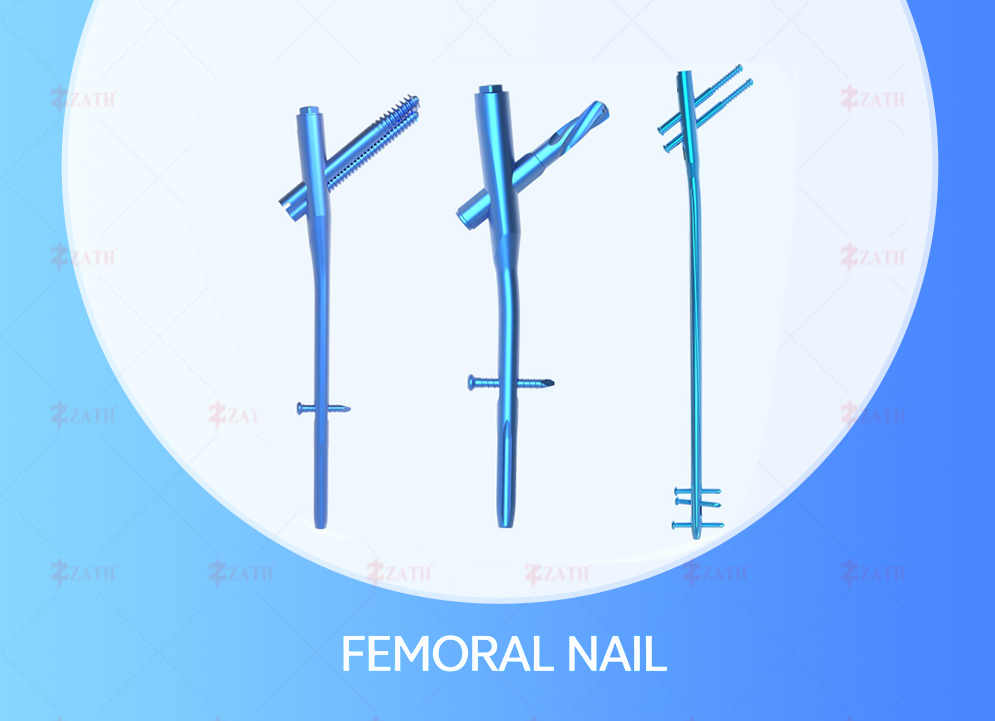
Note: The final selection of Reconstrution Femoral Nails requires a comprehensive judgment based on precise preoperative imaging (X-ray/CT) measurements, intraoperative fluoroscopy conditions, and the operator’s proficiency.
Post time: Sep-16-2026