
The Locking bone plate is a commonly used osteosynthesis implant in orthopedic surgery, mainly used for the fixation and repair of fractures. Its core principle is to form a fixed-angle structure through the “locking screws and the locking plate“, thereby providing stable internal fixation.
I. Orthopedic Bone Plates Composition and Materials
Composition: It mainly consists of a metal plate (with internal threaded holes) and locking screws (with external threads). Some products also include spacers, fixing nuts, and other accessories.
Materials: Usually made of medical titanium alloys (such as pure titanium, titanium alloys) or medical stainless steel, which have good biocompatibility, high strength, and corrosion resistance.
II. Core Advantages and Biomechanical Principles
Angle Stability and Anti-Extraction: After the locking screws and the plate’s threads are locked, they form an “internal fixation framework”, providing angle stability, resistance to bending and torsion. Moreover, the anti-extraction force of the locking screws is significantly higher than that of traditional ordinary screws, making them particularly suitable for patients with osteoporosis.
Minimally invasive technique and biological osteosynthesis: The plate is fixed by adhering to the periosteum without compressing the bone surface. It can preserve the blood supply of the periosteum and the hematoma at the fracture site, allowing for slight movement at the fracture site, which is conducive to bone callus formation and fracture healing.
Suitability for complex fractures: It provides reliable bridging and fixation for complex injuries including comminuted fractures, peri-articular fractures and metaphyseal fractures.
III. Common Types
Locking Compression Plate (LCP): Combines locking and compression functions. Some holes are for locking, while others are for regular compression. It can achieve both locking fixation and compression between the fracture fragments.
Anatomical Locked Plate: Pre-shaped according to the specific bone anatomy of the area (such as the proximal femur, distal radius), providing better fit.
Minimally Invasive reconstruction locking plate (e.g. LISS): Designed with a thin, low-profile construct for percutaneous insertion through small incisions and reduced soft tissue dissection.
IV. What types of locking plates does our company manufacture?
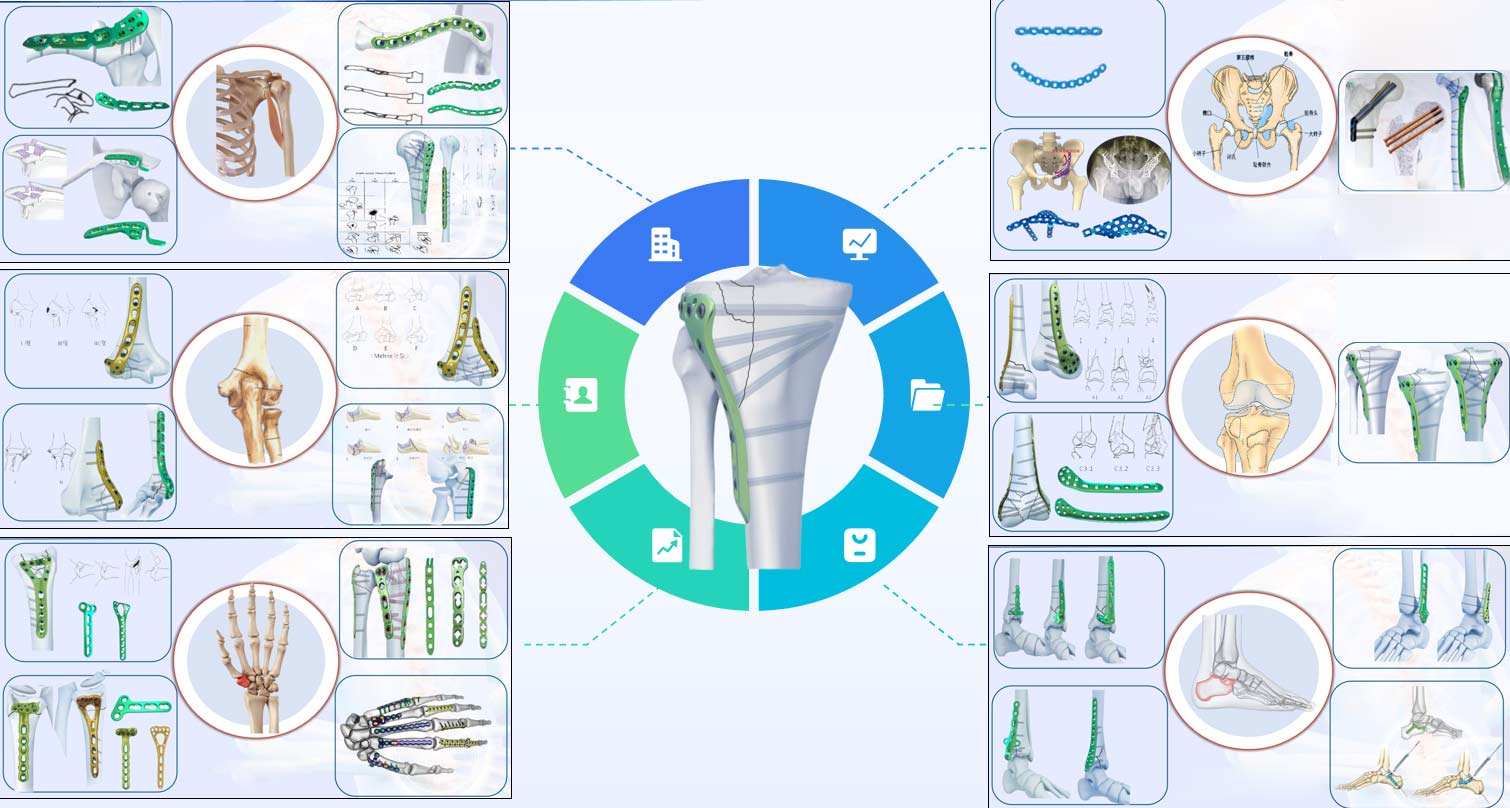
Orthopedic Clavicle Plate Series
Indications: Clavicular fracture, clavicular shaft deformity, acromioclavicular joint dislocation, etc.
Proximal Humerus Locking Plate Series
Indications: Proximal humeral fractures, especially Neer classification two-part, three-part and four-part fractures as well as fracture-dislocations.
Tibia Locking Plate Series
Indications: Used in the surgical treatment of fractures and deformities in the portion of the tibia bone in the lower leg.
Femoral Locking Plate Series
Indications: Used in during femur fracture repairs.
Radius Bone Plate Series
Indications: Distal radius fractures, including Colles’ fracture, Smith’s fracture, Barton’s fracture, etc. Especially suitable for intra-articular comminuted fractures and fractures with poor reduction.
Calcaneus Locking Plate Implants Series
Indications: Calcaneal fractures, including Sanders classification typeII-IV fractures. Particularly applicable to intra-articular comminuted fractures and fractures with abnormal calcaneal length, width and height.
Titanium Hand Plates Series
Indications: Fractures of phalanges, metacarpals, tarsal bones and other hand and foot bones, bone nonunion and joint fusion surgery.
Pelvic Locking Plate Series
Indications: For pelvic fractures and other pelvic injuries.
If you want to learn more about the orthopedic locking plates knowledge, please feel free to contact us; our team will provide you with the professional support and answers.
Post time: Oct-21-2026